

The TSX Composite Index has retreated sharply in the past few weeks, erasing some of the gains made earlier this year when it surged to a record high.
It retreated to $31,000 on Friday, down by nearly 10% from its highest point this year.
TSX Composite Index has slumped as gold and silver prices plunge
The main reason behind the ongoing TSX Composite Index is the ongoing slump in gold and silver prices.
Gold price has dropped to $4,490, its lowest level since February 2nd, and 20% below the all-time high.
Similarly, the silver price has slumped to $67 from the all-time high of $121.
Other metals like copper and aluminium have also tumbled in the past few months.
These metals have dropped because of the ongoing fear that the Federal Reserve will maintain high interest rates this year as inflation has continued rising amid the ongoing Iran war.
In a statement last week, the Federal Reserve hinted that it may hike interest rates this year as inflation is expected to keep rising as energy prices jump.
The risk, however, is that the economy is in a stagflation, a period characterised by high inflation and slow economic growth.
Gold and silver ETFs have continued to experience outflows in the last three consecutive weeks, a sign that investors are selling the recent rally.
Their performance is notable because gold and silver mining companies have a big market share in the TSX Composite Index.
For example, Ivanhoe Mines stock price has dropped by 33% in the last 30 days, while Eldorado Gold Corporation, Taseko Mines, Endeavour Silver, Hudbay Minerals, B2Gold, and IAMGold stocks have slumped by over 25% in the same period.
The slump in silver and gold stocks has been offset by the ongoing rally in energy companies as crude oil and natural gas prices have surged in the past few weeks.
Vermillion Energy stock has soared by 38%, while Strathcona, Parex, Canadian Natural Resources, and Baytex Energy stocks have all jumped by double digits.
Hawkish Bank of Canada interest rate decision
The TSX Index has slumped because of the change in tune by the Bank of Canada, which delivered a relatively hawkish statement last week.
In a statement, the bank left interest rates unchanged at 2.25%, continuing a pause that has been going on in the past few months.
Still, traders are pricing in rate hikes this year as inflation is expected to continue rising in the coming months.
Traders are betting that the bank will hike rates by 75 basis points this year.
This explains why bond yields have continued rising this year, with the ten-year moving to 3.57% and the five-year soaring to 3.25%.
The ongoing TSX Index crash also coincides with that of other global indices.
For example, the S&P 500 Index dropped to $6,487, down by 7.15% from its highest point this year.
Similarly, the Stoxx 50 Index has tumbled to €5,443, down by 11.6% in the same period.
S&P/TSX Composite Index technical analysis
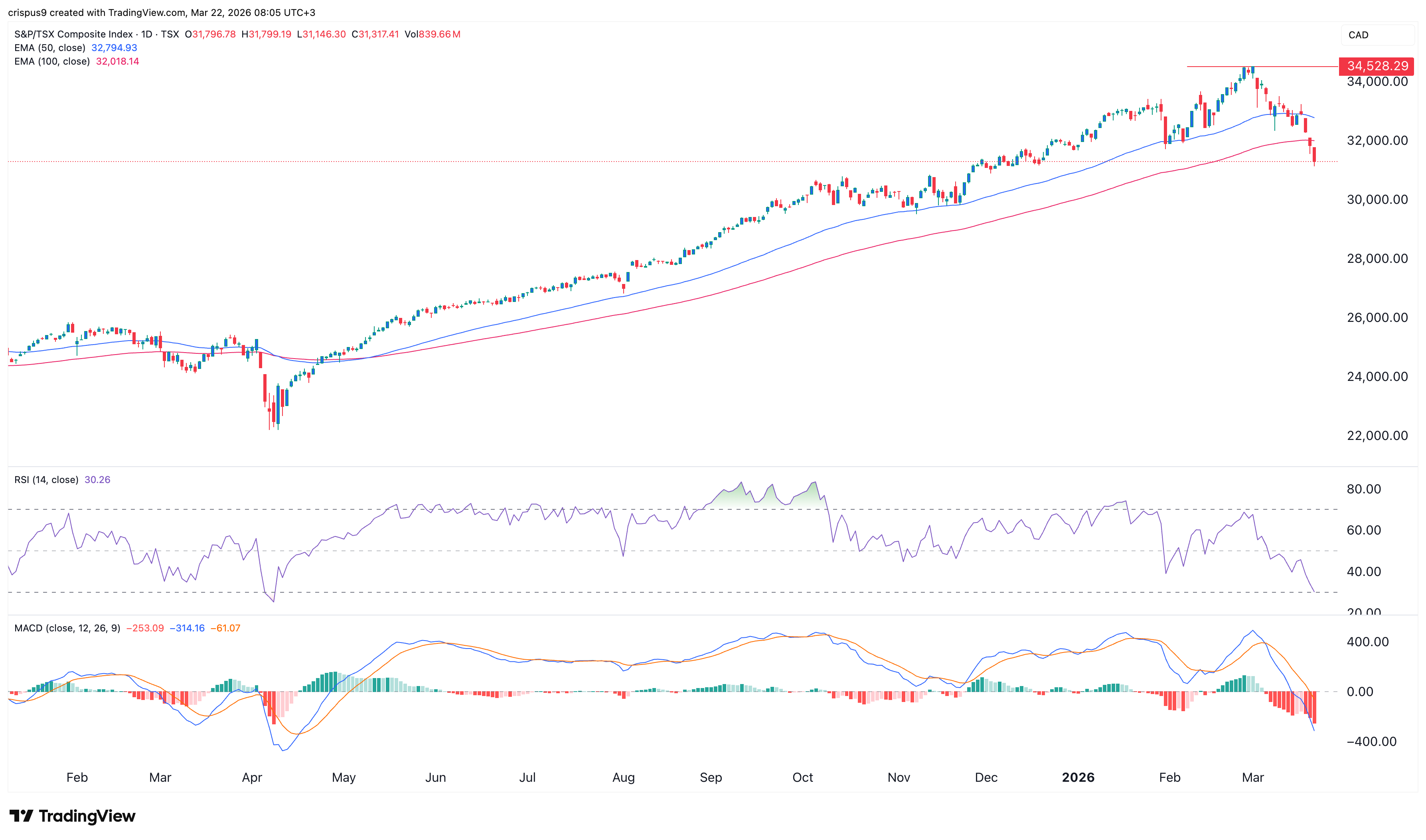
TSX Index chart | Source: TradingView
The daily chart shows that the TSX Index has been in a strong downward trend in the past few weeks, moving from a high of $34,528 to the current $31,317, its lowest level since December 15.
It has dropped below the 50-day and 100-day Exponential Moving Averages (EMA).
Also, the Supertrend indicator has remained red, while top oscillators like the Relative Strength Index (RSI) and the MACD have retreated.
Therefore, the index will likely continue falling as sellers target the key support level at $30,000, which is about 4.38% below the current level.
The post Top 3 reasons why Canada’s TSX Composite has crashed into a correction appeared first on Invezz
